
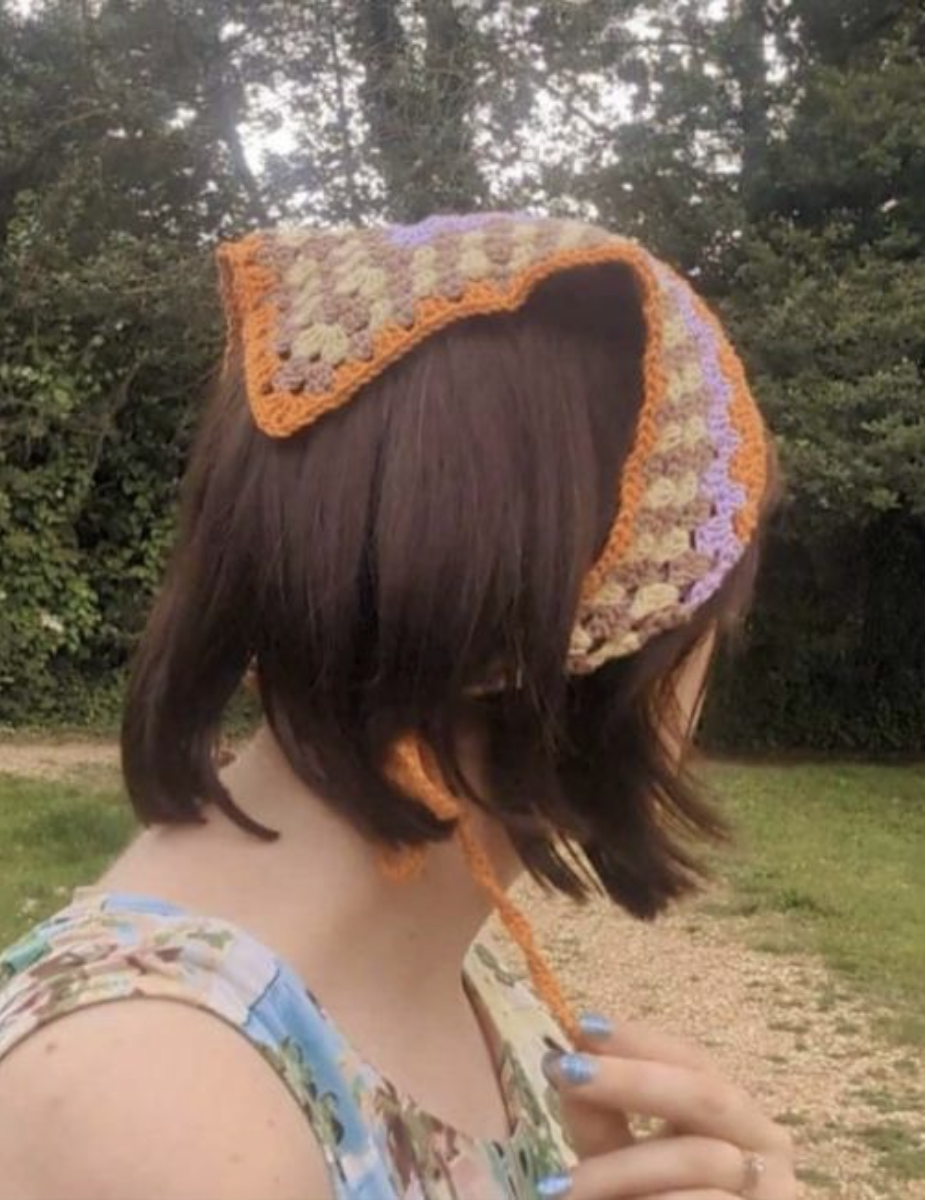

There is something especially satisfying about a crochet accessory that becomes recognizable before it is even finished. The Cruel Summer Bandana has that quality. Its triangular silhouette grows from a tiny ring, the granny-style clusters create an open textured surface, and the sequence of Lilac, Raffia, Vanilla, and Nectarine gives the fabric its distinctive personality.
This third version of the guide is designed as a color-by-color workshop. Instead of treating the project as a generic triangular crochet piece, it follows the visual development of the actual bandana and uses the photographs as checkpoints for shape, texture, and finishing. The written technical information remains based on the supplied To Be Adorned pattern by Becca Parker.
The pattern is written in UK crochet terms and uses a 3mm hook. Its stated finished measurement is approximately 59 x 39 x 39cm, not including ties, and its stated tension is 9 tr sts x 5 rows in pattern using a 3mm hook = 5 x 5cm. The body ends at Row 19 with [116tr, 40ch-sps], followed by two Yarn D ties.
The Four-Color Palette
- Yarn A — Lilac
- Yarn B — Raffia
- Yarn C — Vanilla
- Yarn D — Nectarine
The suggested yarn is Patons 100% Cotton 4ply, 100% cotton, 100g/330m, with 1 ball of each color. The other listed material is a tapestry needle. Keeping the four colors labeled as A, B, C, and D is worthwhile because the sequence does not simply repeat in an uninterrupted four-row cycle.
Before the First Chain
The project is based on a granny half square. The important structural feature is the center ch-2 space. It acts as the turning point for the triangular expansion. Each row starts with ch4, which counts as 1tr and 1ch, moves through three-treble groups in chain spaces, crosses the center with (3tr, ch2, 3tr), and then continues across the opposite side before ending with ch1 and 1tr.
For a beginner, this means the pattern can be read in landmarks instead of as one uninterrupted sentence. Find the starting edge. Work across the available chain spaces. Locate the central ch-2 space. Work the increase. Then repeat the chain-space groups toward the other edge.
Materials and Measurements
- Four shades: cotton 4ply yarn
- Suggested yarn: Patons 100% Cotton 4ply (100% cotton, 100g/330m)
- Amount: 1 ball of each color
- Hook: 3mm crochet hook (US D/3)
- Tapestry needle: required for finishing
- Finished size: Approx 59 x 39 x 39cm, not including ties
- Tension: 9 tr sts x 5 rows in pattern using 3mm hook = 5 x 5cm
Abbreviations Used in the Pattern
- st/sts: stitch/stitches
- sp: space
- beg: beginning
- ch: chain
- ch-sp: chain space
- ss: slip stitch
- dc: double crochet
- tr: treble crochet
- RS: right side
- WS: wrong side
Milestone One: Build the Tiny Center
Using the 3mm hook and Yarn A, ch4 and join with a ss to form a ring. This is the entire foundation. There is no separate foundation chain to measure, and the first row is worked directly into the ring.
Row 1
Row 1 is RS. Ch4, counting as 1tr and 1ch. Work (3tr, ch2, 3tr) into the ring, ch1, 1tr into the ring, turn. The checkpoint is [8tr, 4ch-sps].
Do not judge the finished shape yet. At this point the work is extremely small. What matters is that the central ch-2 space is clearly established, because that space will remain the structural center as every later row becomes wider.
Row 2
Row 2 is WS. Ch4, counting as 1tr and 1ch, 3tr into first ch-sp, ch1, (3tr, ch2, 3tr) into ch-2 sp, ch1, 3tr into next ch-sp, ch1, 1tr, turn. Fasten off. The checkpoint is [14tr, 6ch-sps].

Milestone Two: Introduce the Main Color Rhythm
Rows 3 through 5 make the first clearly visible color sequence. This is where the fabric begins to look like the project shown in the photographs rather than a generic foundation sample.
Row 3 — Yarn B
Join Yarn B. Ch4, counting as 1tr and 1ch, 3tr into first ch-sp, ch1, 3tr into next ch-sp, ch1, (3tr, ch2, 3tr) into ch-2 sp, ch1, (3tr into next ch-sp, ch1) twice, ch1, 1tr, turn. Fasten off. [20tr, 8ch-sps].
Row 4 — Yarn C
Join Yarn C. Ch4, counting as 1tr and 1ch, 3tr into first ch-sp, ch1, (3tr into next ch-sp, ch1) twice, (3tr, ch2, 3tr) into ch-2 sp, ch1, (3tr into next ch-sp, ch1) three times, ch1, 1tr, turn. Fasten off. [26tr, 10ch-sps].
Row 5 — Yarn B
Join Yarn B. Ch4, counting as 1tr and 1ch, 3tr into first ch-sp, ch1, (3tr into next ch-sp, ch1) three times, (3tr, ch2, 3tr) into ch-2 sp, ch1, (3tr into next ch-sp, ch1) four times, ch1, 1tr, turn. Fasten off. [32tr, 12ch-sps].
At the end of this milestone, the stitch count has moved from 8tr to 32tr. That growth is the defining behavior of the half-square. The fabric becomes wider without introducing a new shaping method; the repeated chain-space groups simply become more numerous.
Milestone Three: Grow the Fabric Without Losing the Center
Rows 6–10 are an ideal place to establish a steady working rhythm. The center remains the same. What changes is how many repeated groups appear before and after it.
Row 6 — Yarn C
Join Yarn C, ch4 (counts as 1tr and 1ch), 3tr into first ch-sp, ch1, (3tr into next ch-sp, ch1) four times, (3tr, ch2, 3tr) into ch-2 sp, ch1, (3tr into next ch-sp, ch1) five times times, ch1, 1tr, turn. Fasten off. [38tr, 14ch-sps].
Row 7 — Yarn B
Join Yarn B, ch4 (counts as 1tr and 1ch), 3tr into first ch-sp, ch1, (3tr into next ch-sp, ch1) five times, (3tr, ch2, 3tr) into ch-2 sp, ch1, (3tr into next ch-sp, ch1) six times times, ch1, 1tr, turn. Fasten off. [44tr, 16ch-sps].
Row 8 — Yarn D
Join Yarn D, ch4 (counts as 1tr and 1ch), 3tr into first ch-sp, ch1, (3tr into next ch-sp, ch1) six times, (3tr, ch2, 3tr) into ch-2 sp, ch1, (3tr into next ch-sp, ch1) seven times times, ch1, 1tr, turn. [50tr, 18ch-sps].
Row 9
Ch4 (counts as 1tr and 1ch), 3tr into first ch-sp, ch1, (3tr into next ch-sp, ch1) seven times, (3tr, ch2, 3tr) into ch-2 sp, ch1, (3tr into next ch-sp, ch1) eight times times, ch1, 1tr, turn. [56tr, 20ch-sps].
Row 10
Ch4 (counts as 1tr and 1ch), 3tr into first ch-sp, ch1, (3tr into next ch-sp, ch1) eight times, (3tr, ch2, 3tr) into ch-2 sp, ch1, (3tr into next ch-sp, ch1) nine times times, ch1, 1tr, turn. [62tr, 22ch-sps].

A Simple Way to Read the Long Rows
Once the project reaches the middle, the written rows look long because the number of repeated groups increases. A useful reading strategy is to mentally divide every row into three sections: the groups before the center, the central (3tr, ch2, 3tr), and the groups after the center.
The stitch-count checkpoints reinforce this structure. From Row 1 through Row 19, the stated treble counts progress as 8, 14, 20, 26, 32, and so on. The chain-space counts also increase in a regular sequence. These counts should be treated as verification points rather than as permission to change a row if the number does not match.
Milestone Four: The Wide Middle Section
Row 11
Ch4 (counts as 1tr and 1ch), 3tr into first ch-sp, ch1, (3tr into next ch-sp, ch1) nine times, (3tr, ch2, 3tr) into ch-2 sp, ch1, (3tr into next ch-sp, ch1) 10 times times, ch1, 1tr, turn. Fasten off. [68tr, 24ch-sps].
Row 12 — Yarn A
Join Yarn A, ch4 (counts as 1tr and 1ch), 3tr into first ch-sp, ch1, (3tr into next ch-sp, ch1) nine times, (3tr, ch2, 3tr) into ch-2 sp, ch1, (3tr into next ch-sp, ch1) 10 times times, ch1, 1tr, turn. [74tr, 26ch-sps].
Row 13
Ch4 (counts as 1tr and 1ch), 3tr into first ch-sp, ch1, (3tr into next ch-sp, ch1) 10 times, (3tr, ch2, 3tr) into ch-2 sp, ch1, (3tr into next ch-sp, ch1) 11 times times, ch1, 1tr, turn. Fasten off. [80tr, 28ch-sps].
Row 14 — Yarn B
Join Yarn B, ch4 (counts as 1tr and 1ch), 3tr into first ch-sp, ch1, (3tr into next ch-sp, ch1) 11 times, (3tr, ch2, 3tr) into ch-2 sp, ch1, (3tr into next ch-sp, ch1) 12 times times, ch1, 1tr, turn. Fasten off. [86tr, 30ch-sps].
Row 15 — Yarn C
Join Yarn C, ch4 (counts as 1tr and 1ch), 3tr into first ch-sp, ch1, (3tr into next ch-sp, ch1) 12 times, (3tr, ch2, 3tr) into ch-2 sp, ch1, (3tr into next ch-sp, ch1) 13 times times, ch1, 1tr, turn. Fasten off. [92tr, 32ch-sps].
At Row 15, the piece is no longer a tiny sample. This is a good point to lay it flat and compare the overall triangular direction with the project photographs. The visual check is especially useful for confirming that the fabric is expanding from the intended center rather than drifting to one side.

Milestone Five: Finish the Main Body
Row 16 — Yarn B
Join Yarn B, ch4 (counts as 1tr and 1ch), 3tr into first ch-sp, ch1, (3tr into next ch-sp, ch1) 13 times, (3tr, ch2, 3tr) into ch-2 sp, ch1, (3tr into next ch-sp, ch1) 14 times times, ch1, 1tr, turn. Fasten off. [98tr, 34ch-sps].
Row 17 — Yarn C
Join Yarn C, ch4 (counts as 1tr and 1ch), 3tr into first ch-sp, ch1, (3tr into next ch-sp, ch1) 14 times, (3tr, ch2, 3tr) into ch-2 sp, ch1, (3tr into next ch-sp, ch1) 15 times times, ch1, 1tr, turn. Fasten off. [104tr, 36ch-sps].
Row 18 — Yarn B
Join Yarn B, ch4 (counts as 1tr and 1ch), 3tr into first ch-sp, ch1, (3tr into next ch-sp, ch1) 15 times, (3tr, ch2, 3tr) into ch-2 sp, ch1, (3tr into next ch-sp, ch1) 16 times times, ch1, 1tr, turn. Fasten off. [110tr, 38ch-sps].
Row 19 — Yarn D
Row 19 is RS. Join Yarn D, ch4 (counts as 1tr and 1ch), 3tr into first ch-sp, ch1, (3tr into next ch-sp, ch1) 16 times, (3tr, ch2, 3tr) into ch-2 sp, ch1, (3tr into next ch-sp, ch1) 17 times times, ch1, 1tr, turn. Fasten off. [116tr, 40ch-sps].

The Two Ties
The ties use Yarn D and are attached only after the main triangle has reached Row 19. This separation is useful because it means the triangular body is finished before the functional fastening is added.
First Tie
With the RS facing, join Yarn D into the ch-1 sp at the start of Row 19, then ch62.
Row 1 (RS): Starting in the second ch from the hook, 60dc. Fasten off. [62dc].
Second Tie
With the RS facing, rejoin Yarn D into the ch-1 sp at the end of Row 19, ch62. Work as Row 1.
Finally, weave in all ends.

How the Finished Shape Should Read
The finished main piece should present a broad triangle with the color bands distributed across the expanding granny structure. The two equal tie constructions then extend from the two ends of Row 19. The source’s approximate body measurement is 59 x 39 x 39cm, excluding the ties.
Because the pattern is written for a 3mm hook and gives a specific tension, reproducing the stated size begins with using the specified materials and checking the tension. If the fabric is significantly tighter or looser, changing the row sequence is not the appropriate first response. Instead, compare your tension with the supplied gauge information.
Visual Checkpoints for Each Stage
- After Row 2: the center and first triangular expansion should be established.
- After Row 5: the first visible color rhythm is developing.
- After Row 10: the triangle is clearly widening and the repeated granny groups should be easy to identify.
- After Row 15: the body is substantially larger and the symmetry around the central ch-2 space is easy to inspect.
- After Row 19: the complete triangular body reaches [116tr, 40ch-sps].
- After the ties: the accessory is ready to wear after weaving in all ends.
Common Problems and What to Check
My triangle is not symmetrical.
Locate the central ch-2 space first. Then compare the repeated groups on each side of it with the written row. The stitch-count checkpoint at the end of the row is the most reliable verification.
I lost track of the center.
Pause before beginning the central increase. The repeated groups should lead you toward the ch-2 space. Once you work (3tr, ch2, 3tr) there, continue through the specified chain-space groups on the other side.
I am unsure which color comes next.
Use the Yarn A–D labels from the written pattern. The sequence is not simply A, B, C, D repeated in order. For example, Yarn B returns frequently, while Yarn A is specifically joined again at Row 12.
The finished piece is not the stated size.
Check the specified tension: 9 tr sts x 5 rows in pattern using 3mm hook = 5 x 5cm. Also confirm that the 3mm hook and the specified cotton 4ply yarn are being used.
The ties look misplaced.
Both attachment points are specified on Row 19. The first is the ch-1 sp at the start of Row 19 and the second is the ch-1 sp at the end of Row 19, with the RS facing.
Full Row Checkpoint List
| Row | Stitch Count |
|---|---|
| 1 | [8tr, 4ch-sps] |
| 2 | [14tr, 6ch-sps] |
| 3 | [20tr, 8ch-sps] |
| 4 | [26tr, 10ch-sps] |
| 5 | [32tr, 12ch-sps] |
| 6 | [38tr, 14ch-sps] |
| 7 | [44tr, 16ch-sps] |
| 8 | [50tr, 18ch-sps] |
| 9 | [56tr, 20ch-sps] |
| 10 | [62tr, 22ch-sps] |
| 11 | [68tr, 24ch-sps] |
| 12 | [74tr, 26ch-sps] |
| 13 | [80tr, 28ch-sps] |
| 14 | [86tr, 30ch-sps] |
| 15 | [92tr, 32ch-sps] |
| 16 | [98tr, 34ch-sps] |
| 17 | [104tr, 36ch-sps] |
| 18 | [110tr, 38ch-sps] |
| 19 | [116tr, 40ch-sps] |
The table is only a quick reference. The actual row instructions above preserve the sequence of stitches, chain spaces, color joins, turns, and fastening-off instructions from the supplied pattern. If a checkpoint does not match, return to the corresponding row rather than inventing a new increase or decrease.
Frequently Asked Questions
What is the Cruel Summer Bandana made from?
The source specifies four shades of cotton 4ply yarn, with Patons 100% Cotton 4ply suggested, plus a 3mm crochet hook and tapestry needle.
What are the four colors?
Yarn A is Lilac, Yarn B is Raffia, Yarn C is Vanilla, and Yarn D is Nectarine.
How large is the finished bandana?
Approximately 59 x 39 x 39cm, not including ties.
What is the tension?
9 tr sts x 5 rows in pattern using 3mm hook = 5 x 5cm.
How many rows make the triangular body?
The body is worked through Row 19.
What is the final count of Row 19?
[116tr, 40ch-sps].
How long are the tie foundations?
Each tie begins with ch62, followed by 60dc worked from the second chain from the hook, with the stated count [62dc].
Which crochet terminology does the pattern use?
UK crochet terms.
Finishing the Project
After the second tie has been completed, weave in all ends. No additional border or extra shaping is specified in the supplied pattern. Keeping the finishing stage simple preserves the original construction: a granny half square followed by two ties.
The photographs show why the restrained construction works so well. The triangular silhouette provides the recognizable bandana shape, while the alternating colors create most of the visual interest. The open granny-style spaces also allow the color bands to remain distinct as the triangle becomes larger.

Final Make Checklist
- 3mm hook ready.
- Four cotton 4ply shades prepared.
- Yarn A = Lilac.
- Yarn B = Raffia.
- Yarn C = Vanilla.
- Yarn D = Nectarine.
- Foundation ring completed with ch4 and ss.
- Central ch-2 space preserved throughout the body.
- Rows 1–19 completed using the supplied instructions.
- Row 19 checked at [116tr, 40ch-sps].
- First tie attached at the start-of-Row-19 ch-1 space.
- Second tie attached at the end-of-Row-19 ch-1 space.
- Both ties worked from ch62 with 60dc from the second chain.
- All ends woven in.
The Cruel Summer Bandana is a strong project for practicing consistency. The individual stitch operations are familiar, but the expanding row length teaches you to recognize chain spaces, preserve a central turning point, and use stitch counts as checkpoints. The changing colors add visual motivation without requiring a different construction technique for each stripe.
For the cleanest result, keep the technical details exactly as written: the 3mm hook, cotton 4ply yarn, four specified colors, UK terminology, row sequence, stitch counts, and tie placement. Use the photographs to understand how the fabric should look as it grows, but use the written pattern for the exact execution details.
The supplied source credits Becca Parker of To Be Adorned, ©2024, and states that the pattern is for personal and non-commercial use only. It asks makers to credit To Be Adorned when using the pattern and invites makers to follow and tag @tobeadorned when sharing their makes online.
Once the ends are woven in, the project is complete: a colorful triangular crochet headscarf with a granny-inspired surface and two simple ties, ready to style as shown in the finished photographs.