
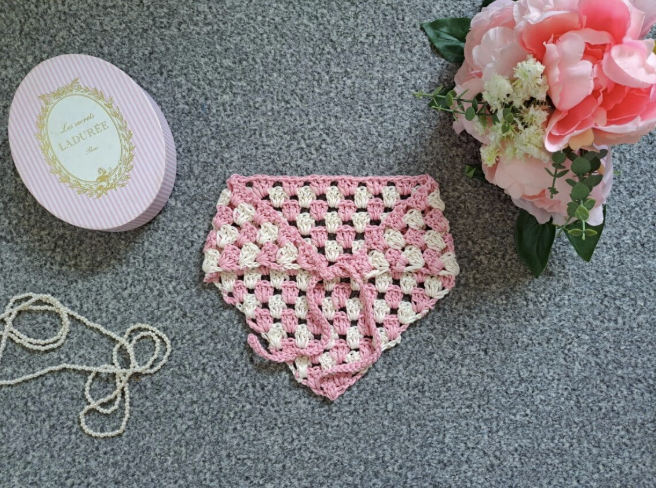
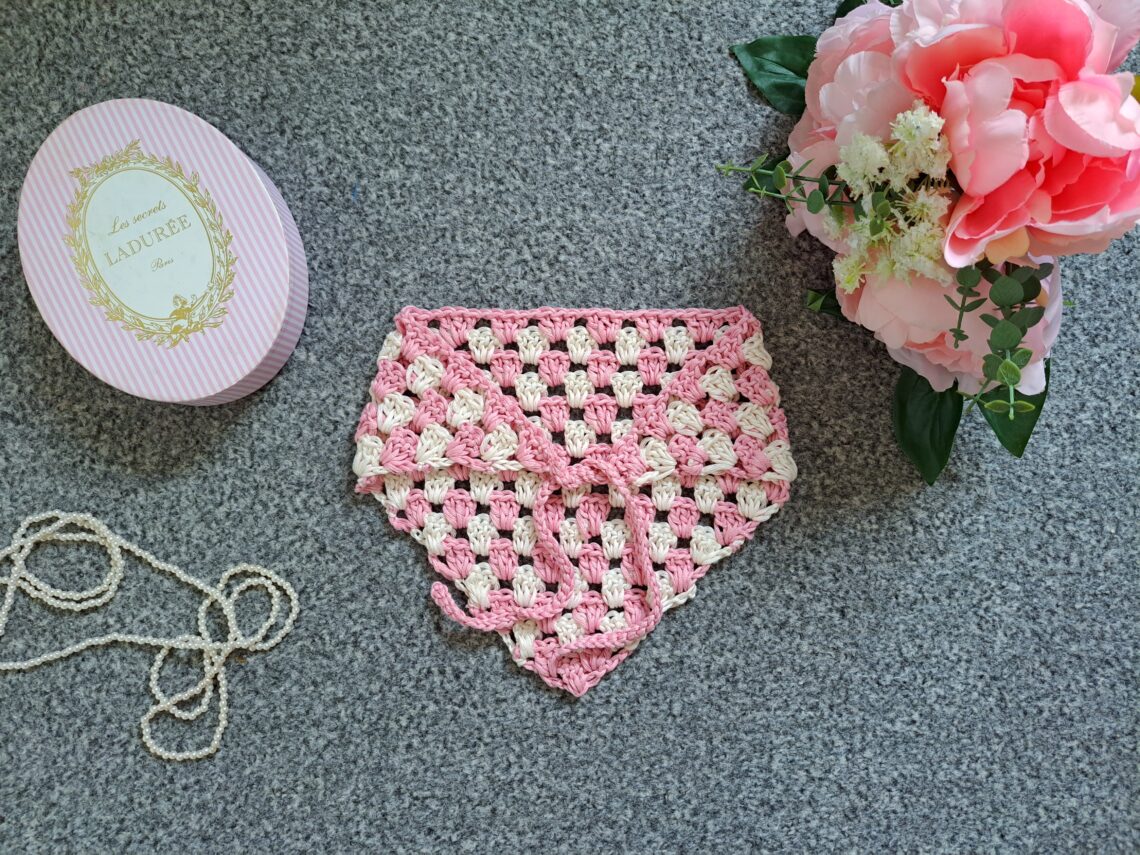
A handmade crochet accessory does not need a complicated stitch pattern to make a beautiful impression. The Crochet Cottagecore Bandana is a perfect example. It uses a classic Granny Triangle construction, two soft yarn shades, and simple ties to create a romantic accessory with a distinctly handmade character.
This beginner-friendly project is worked from a small starting ring and gradually increased row by row until the triangular bandana reaches its finished size. The pattern uses Drops Muskat in shade 06 Desert Rose and shade 08 Off White, with the colors alternated from row to row. The result is a delicate striped effect that suits the soft, nostalgic feeling associated with Cottagecore style.
The project is particularly enjoyable because the basic stitch sequence remains consistent while the triangle grows. Once the first few rows are familiar, the later rows become a matter of following the increasing number of Granny Triangle repeats. This makes the pattern suitable for crocheters who want a relaxing project while also practicing accurate stitch placement and color changes.
What Makes This Bandana Special?
The Cottagecore aesthetic is often associated with rural-inspired living, romantic clothing, handmade details, soft fabrics, pastel colors, and delicate floral influences. Crochet naturally complements this style because every finished piece carries the visual character of something made by hand.
This bandana takes that aesthetic and translates it into a simple wearable accessory. Rather than relying on a complicated lace motif, the design lets the triangular shape and alternating colors create the visual interest.

The Granny Triangle stitch is also an excellent choice for this type of project. It is familiar to many crocheters from shawls and other triangular accessories, yet it works just as well on a smaller scale. The growing triangle is easy to recognize visually, making it easier for beginners to monitor their progress.
Choosing the Yarn and Color Combination
The original project uses Drops Muskat yarn in two shades: 06 Desert Rose and 08 Off White. The Desert Rose shade provides the soft pink element, while Off White adds a light cream contrast.
One skein of each color is required. The pattern alternates the shades from row to row, so the color changes become an important part of the finished appearance.
Rather than carrying one unused color along the edge, the instructions call for the yarn being used to be fastened off after each row and the opposite shade to be attached. This creates the intended alternating-row effect.

The simplicity of the color palette is one of the strengths of the design. The two shades are enough to create visual definition without making the project feel busy. The alternating rows also make the progression of the triangle easy to see.
Pattern Information Before You Begin
Before starting the crochet work, take a moment to familiarize yourself with the measurements, gauge, terminology, and supplies. This will make the pattern easier to follow from the foundation ring through the final straps.
- Difficulty: Easy/beginner
- Finished bandana size: 8.5 inches x 17 inches (21.5 cm x 43 cm), excluding the ties on each side
- Gauge: 4 inches (10 cm): 8 rows of Granny Triangle pattern
- Crochet hook: 4 mm
- Yarn: Drops Muskat
- Yarn shade 1: 06 Desert Rose
- Yarn shade 2: 08 Off White
- Straps: 35 chains for each strap
- Crochet terminology: US terms, with British terms in brackets
Materials Checklist
The supply list is short, which is another reason this project works well for beginners. You do not need a large collection of tools to make the bandana.
- 1 skein of Drops Muskat in shade 06 Desert Rose
- 1 skein of Drops Muskat in shade 08 Off White
- A 4 mm crochet hook
- A pair of scissors
- A tapestry needle

Keep the scissors and tapestry needle close by because the pattern requires repeated fastening off and reattachment of yarn during the color changes.
Understanding the Crochet Abbreviations
- Ch: chain
- St: stitch
- Sl st: slip stitch
- DC: Double Crochet (UK Treble Crochet)
- EOR: End of row
The pattern is written using US crochet terms. This is particularly important for the abbreviation DC. In US terminology, DC means Double Crochet, while the corresponding stitch is known as Treble Crochet in UK terminology.
Starting the Bandana: The Foundation Ring
Begin with shade 06 Desert Rose. Make a slip knot with the pink yarn. Chain 4, then slip stitch through the first chain to form a ring.
This small ring is the starting point for the entire triangular fabric. The first row is worked into the center of this ring, establishing the initial Granny Triangle structure.
Row 1
Chain 4. This counts as 1 DC plus a chain space. Work 3 DC in the circle. Then chain 1 and work 1 DC in the circle.
At this stage, the piece will be very small. Do not be concerned if it does not yet resemble a bandana. The recognizable triangular form develops as additional rows are added.
Row 2
Turn your work. Chain 4, counting as 1 DC plus a chain space. Place 3 DC inside the next space. Chain 1. Work 3 DC, chain 1, and 1 DC inside the next and last space.
Fasten off the yarn at the end of Row 2.

Introducing the Off White Row
After fastening off the Desert Rose yarn, attach shade 08 Off White to the same corner where you fastened off. This keeps the color transition positioned at the edge of the triangle.
Row 3
Turn your work. Chain 4, counting as 1 DC plus a chain space. Place 3 DC in the next space. Chain 1, then place 3 DC in the next space. Chain 1, 3 DC, chain 1, and 1 DC in the next and last space.
Fasten off the Off White yarn after completing the row.

At this point, you can clearly begin to see how the triangle is developing. The alternating colors also make the individual rows easier to distinguish.
Row 4 and the Repeating Construction
Attach shade 06 Desert Rose to the same corner where you just fastened off.
Row 4
Chain 4, counting as 1 DC plus a chain 1 space. Place 3 DC in the next space. Then work [ch 1, 3 DC in next sp] 2 times. Finish with ch 1, 3 DC, ch 1, and 1 DC in the next and last space.
After completing Row 4, fasten off the Desert Rose yarn. Attach the other shade for the next row. Continue alternating colors from row to row throughout the remainder of the triangle.

Following Rows 5 Through 16
The remaining rows use the same basic structure. The important change is the number of times the bracketed repeat is worked. With every new row, the number of [ch 1, 3 DC in next sp] repetitions increases by one.
This progression is the key to creating the triangular shape. Instead of changing the construction method, you simply add another repeat as the row becomes wider.
Row 5
Ch 4 (=1 DC + ch 1 sp), place 3 DC in next sp; [ch 1, 3 DC in next sp] 3 times; ch 1, 3 DC, ch 1, 1 DC in next and last sp.
Row 6
Ch 4 (=1 DC + ch 1 sp), place 3 DC in next sp; [ch 1, 3 DC in next sp] 4 times; ch 1, 3 DC, ch 1, 1 DC in next and last sp.
Row 7
Ch 4 (=1 DC + ch 1 sp), place 3 DC in next sp; [ch 1, 3 DC in next sp] 5 times; ch 1, 3 DC, ch 1, 1 DC in next and last sp.
Row 8
Ch 4 (=1 DC + ch 1 sp), place 3 DC in next sp; [ch 1, 3 DC in next sp] 6 times; ch 1, 3 DC, ch 1, 1 DC in next and last sp.
Row 9
Ch 4 (=1 DC + ch 1 sp), place 3 DC in next sp; [ch 1, 3 DC in next sp] 7 times; ch 1, 3 DC, ch 1, 1 DC in next and last sp.
Row 10
Ch 4 (=1 DC + ch 1 sp), place 3 DC in next sp; [ch 1, 3 DC in next sp] 8 times; ch 1, 3 DC, ch 1, 1 DC in next and last sp.
Row 11
Ch 4 (=1 DC + ch 1 sp), place 3 DC in next sp; [ch 1, 3 DC in next sp] 9 times; ch 1, 3 DC, ch 1, 1 DC in next and last sp.
Row 12
Ch 4 (=1 DC + ch 1 sp), place 3 DC in next sp; [ch 1, 3 DC in next sp] 10 times; ch 1, 3 DC, ch 1, 1 DC in next and last sp.
Row 13
Ch 4 (=1 DC + ch 1 sp), place 3 DC in next sp; [ch 1, 3 DC in next sp] 11 times; ch 1, 3 DC, ch 1, 1 DC in next and last sp.
Row 14
Ch 4 (=1 DC + ch 1 sp), place 3 DC in next sp; [ch 1, 3 DC in next sp] 12 times; ch 1, 3 DC, ch 1, 1 DC in next and last sp.
Row 15
Ch 4 (=1 DC + ch 1 sp), place 3 DC in next sp; [ch 1, 3 DC in next sp] 13 times; ch 1, 3 DC, ch 1, 1 DC in next and last sp.
Row 16
Ch 4 (=1 DC + ch 1 sp), place 3 DC in next sp; [ch 1, 3 DC in next sp] 14 times; ch 1, 3 DC, ch 1, 1 DC in next and last sp.
Row 16 must be completed in shade 06 Desert Rose. Do not fasten off the Desert Rose yarn because it will be used immediately to create the first strap.
A Simple Way to Check Your Rows
The growing number of repeats provides an excellent checkpoint for beginners. Rather than trying to judge the entire triangle visually, check the number of times the bracketed sequence is worked.
- Row 5: 3 repeats
- Row 6: 4 repeats
- Row 7: 5 repeats
- Row 8: 6 repeats
- Row 9: 7 repeats
- Row 10: 8 repeats
- Row 11: 9 repeats
- Row 12: 10 repeats
- Row 13: 11 repeats
- Row 14: 12 repeats
- Row 15: 13 repeats
- Row 16: 14 repeats
This increasing sequence is one of the easiest ways to catch an error before it becomes difficult to correct. If a row appears to have too few or too many sections, it is worth checking the previous row before continuing.
Maintaining the Alternating Color Pattern
The color sequence is another useful progress marker. The yarn alternates from row to row throughout the project. Rows 1 and 2 begin in Desert Rose, Row 3 uses Off White, Row 4 returns to Desert Rose, and the alternating sequence continues through Row 16.
When you finish each row, fasten off the current color and attach the opposite shade at the same corner. Keeping this process consistent will help preserve the clean striped appearance.
The final row must be Desert Rose. This is important not only for the intended color sequence but also because the Desert Rose yarn remains attached for the first strap.
Making the First Strap
The body of the bandana is complete after Row 16. The next stage is to create the two thin ties that allow the accessory to be secured.
With the Desert Rose yarn still attached, begin Strap 1 by chaining 35.
Once all 35 chains have been made, slip stitch through the second chain and every chain across. Continue until you reach the end of the chain.
When you reach the end, slip stitch through the Double Crochet on the side of the bandana to secure the strap fully onto the project.

Fasten off after securing the first strap.
Making the Second Strap
For Strap 2, attach the yarn to the other side corner of the bandana. Chain 35.

Once you have chained 35, slip stitch through the second chain and every chain across. At the end of the chain, slip stitch through the Double Crochet on the side of the bandana to secure the strap fully onto the project.
The two straps complete the basic construction of the bandana. Each side receives the same 35-chain foundation, giving the finished accessory its ties.
Tips for Working the Pattern Smoothly
Although the project is rated easy/beginner, a few simple habits can make the process much more enjoyable.
Work With the Chain Spaces
The Granny Triangle construction depends heavily on working into spaces. When beginning each row, identify the next available space before placing the group of 3 DC. This makes the repeated structure much easier to follow.
Keep Track of the Repeats
The number of central repeats increases by one with every new row. Counting them is more reliable than simply estimating the size of the growing triangle.
Pay Attention to Color Changes
Since the project alternates Desert Rose and Off White, check the color before beginning every row. Fastening off and reattaching the opposite shade is part of the intended construction.
Protect the Final Yarn Connection
Do not fasten off the Desert Rose yarn at the end of Row 16. That attached yarn is needed to begin Strap 1.
Take Care With the Straps
Both straps begin with exactly 35 chains. Work the slip stitches from the second chain across, then secure each strap to the appropriate side Double Crochet.
Gauge and Finished Measurements
The stated gauge for this project is 4 inches (10 cm): 8 rows of Granny Triangle pattern. The finished bandana measures 8.5 inches by 17 inches (21.5 cm by 43 cm), excluding the ties on each side.
These measurements refer to the completed triangular bandana body rather than the additional length created by the two straps. The ties are created separately after the 16-row triangle is finished.
For a project where the original measurements matter, using the specified 4 mm crochet hook and Drops Muskat yarn helps maintain the intended construction. Keep your tension as consistent as possible while working the rows.
Why This Is a Great Beginner Crochet Project
This bandana introduces several useful techniques without requiring a large or complicated project. Beginners can practice forming a starting ring, turning rows, working double crochet stitches into spaces, reading bracketed repeats, changing colors, fastening off, reattaching yarn, and making simple straps.
The small scale of the accessory also means that the project can be approached in manageable stages. The first few rows establish the pattern, the middle section builds the triangle, and the final stage adds the ties.
The repetitive Granny Triangle construction can also make the later rows relaxing. Once you understand how the number of repeats increases, the pattern becomes predictable and easier to read.
Quick Beginner Checklist
- Use a 4 mm crochet hook.
- Prepare one skein of Drops Muskat shade 06 Desert Rose.
- Prepare one skein of Drops Muskat shade 08 Off White.
- Use US crochet terminology.
- Begin with a slip knot in Desert Rose.
- Make the initial chain-4 ring.
- Complete Rows 1 and 2 in Desert Rose.
- Change to Off White for Row 3.
- Continue alternating the two shades.
- Increase the bracketed repeat by one on each row.
- Complete Row 16 in Desert Rose.
- Keep Desert Rose attached after Row 16.
- Make Strap 1 with 35 chains.
- Make Strap 2 with 35 chains.
- Secure each strap with slip stitches as instructed.
Frequently Asked Questions
Is this crochet bandana suitable for beginners?
Yes. The pattern is rated easy/beginner and is based on a repetitive Granny Triangle construction. Beginners should be comfortable with chains, slip stitches, Double Crochet stitches, and working into spaces.
What crochet terminology does the pattern use?
The pattern uses US crochet terms, with British terms given in brackets. In particular, DC means Double Crochet in US terminology and UK Treble Crochet in British terminology.
What yarn is used for the bandana?
The project uses Drops Muskat. The two specified shades are 06 Desert Rose and 08 Off White, with one skein of each shade required.
What size crochet hook is needed?
The specified hook size is 4 mm.
How many rows are worked in the triangular body?
The main triangular section is worked through Row 16. Row 16 is completed in Desert Rose, and the yarn is left attached for the first strap.
How long is each strap?
Each strap begins with a chain of 35. After making the 35 chains, slip stitch through the second and every chain across before securing the strap to the side of the bandana.
What is the finished size?
The finished bandana body measures 8.5 inches x 17 inches (21.5 cm x 43 cm), excluding the ties on each side.
Enjoying the Finished Handmade Accessory
Once both straps have been completed and secured, the Cottagecore Bandana is ready to become a charming addition to a handmade wardrobe. The combination of the triangular shape, soft Desert Rose and Off White colors, and classic Granny-style construction gives the finished piece a romantic and timeless appearance.
The project demonstrates how effective a simple crochet idea can be. Instead of adding many decorative elements, the design allows the yarn colors, stitch rhythm, and triangular silhouette to work together.
For beginners, it is also a useful reminder that a small accessory can provide plenty of opportunities to practice important crochet techniques. The growing rows offer repeated opportunities to check stitch placement, while the alternating colors encourage careful attention to the end of each row.
The most important thing is to follow the stated row progression and keep the color changes consistent. Once the 16-row triangle is complete, the two 35-chain straps provide the final construction detail.
Final Thoughts
The Crochet Cottagecore Bandana is a simple, romantic, and practical project built around a timeless Granny Triangle technique. With only two yarn shades and a small selection of basic tools, it creates a wearable accessory with plenty of handmade charm.
The pattern’s easy construction makes it approachable for beginners, while the alternating Desert Rose and Off White rows keep the project visually interesting. The gradual increase from Row 1 through Row 16 also makes the growth of the triangle satisfying to watch.
As you work, use the row numbers and repeat counts as your main checkpoints. Keep the color sequence organized, pay attention to the chain spaces, and remember that Row 16 finishes in Desert Rose so the first strap can be worked directly from the attached yarn.
With its soft palette, classic triangular silhouette, and simple tie construction, this handmade bandana is a lovely way to bring a little Cottagecore-inspired character to an everyday outfit while practicing the foundations of Granny Triangle crochet.