
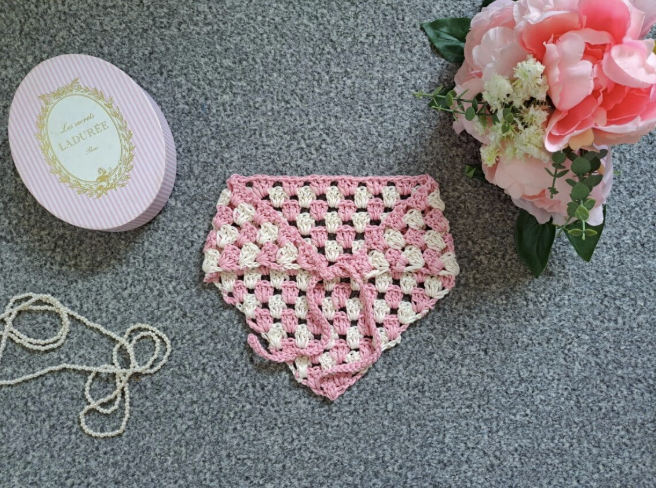
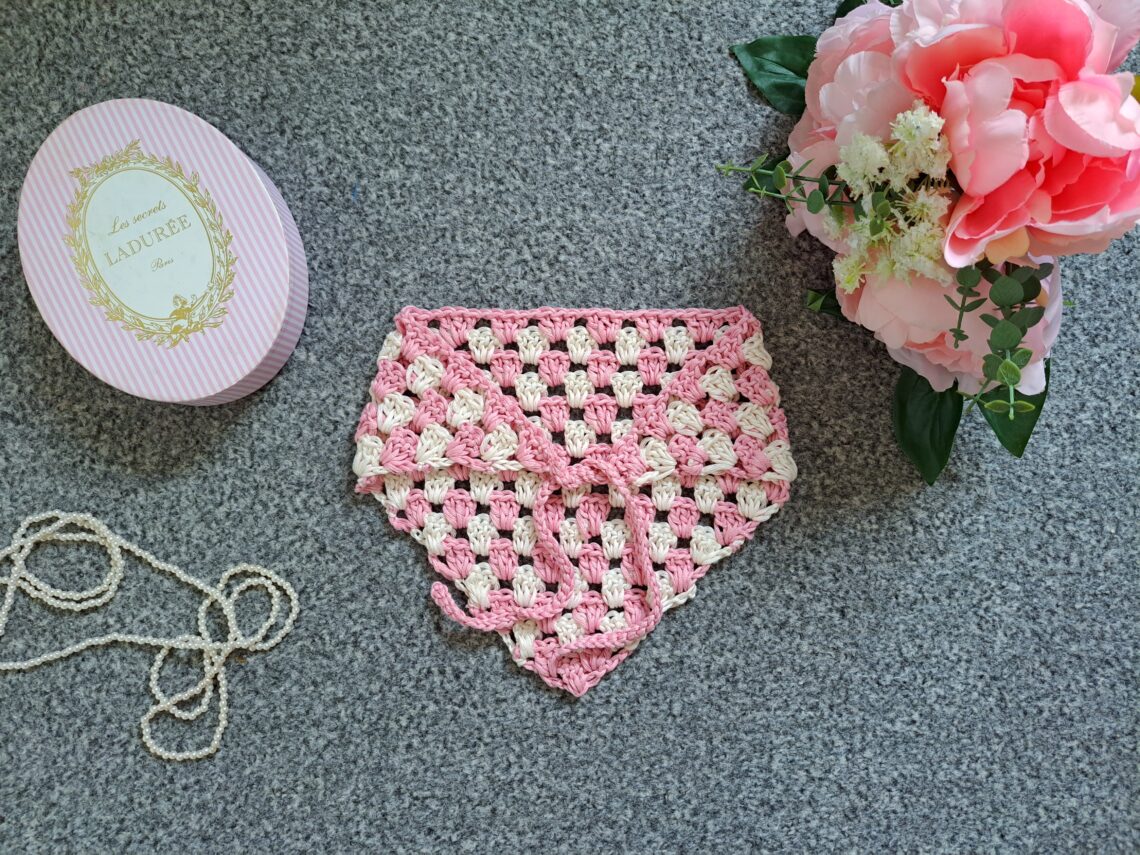
If you love soft colors, handmade accessories, simple vintage-inspired designs, and the romantic charm of Cottagecore style, this crochet Cottagecore bandana is a lovely project to add to your handmade wardrobe. The design combines a classic Granny Triangle pattern with two delicate shades, creating a lightweight head kerchief that feels both practical and decorative.
This is an easy and beginner-friendly crochet project. The construction is based on a straightforward triangular shape, so there are no complicated shaping techniques to master. The main fabric is created row by row with double crochet stitches and chain spaces, while the alternating colors give the finished bandana its distinctive striped appearance.
The finished bandana measures approximately 8.5 inches by 17 inches (21.5 cm by 43 cm), excluding the ties on either side. The pattern uses a 4 mm crochet hook and Drops Muskat yarn in two shades: 06 Desert Rose and 08 Off White.
One of the most enjoyable features of this project is the rhythm of the Granny Triangle stitch. Once the first few rows are established, the pattern becomes very repetitive and easy to follow. Each new row increases the number of Granny-style groups across the triangle, gradually creating the characteristic shape of the bandana.
Why This Crochet Bandana Has a Cottagecore Feel
Cottagecore is strongly associated with an appreciation for rural-inspired living, handmade objects, soft clothing, natural textures, delicate colors, and romantic vintage details. Crochet fits naturally into this aesthetic because the finished fabric has an unmistakably handmade character.
This particular bandana embraces that feeling without becoming overly complicated. Instead of using a highly elaborate stitch pattern, the design relies on the beauty of a classic Granny Triangle construction. The simplicity allows the yarn colors and triangular silhouette to become the main visual features.

The combination of Desert Rose and Off White is particularly effective for a spring and summer accessory. The pink shade provides a gentle focal point, while the cream shade keeps the overall appearance soft and neutral. Alternating the colors from one row to the next creates a subtle striped effect without requiring complicated colorwork.
A Simple Granny Triangle Design
The Granny Triangle stitch is the central technique used throughout this project. It is a classic crochet construction that works especially well for triangular accessories, including shawls, scarves, kerchiefs, and bandanas.
For this design, the triangle begins with a small ring and grows outward with every row. Each new row contains one more internal chain-space section than the previous row. This gradual increase is what creates the triangular shape.

The pattern also alternates two colors. Rows 1 and 2 are worked in Desert Rose, Row 3 changes to Off White, and the colors continue alternating from row to row. The final row, Row 16, should be completed in Desert Rose.
Because the color changes happen at the end of each row, it is useful to keep your two yarn shades organized while working. This will make it easier to identify which color should be attached for the next row and will help preserve the intended alternating sequence.
Project Details at a Glance
- Skill level: Easy/beginner
- Finished size: 8.5 inches x 17 inches (21.5 cm x 43 cm), excluding ties on each side
- Gauge: 4 inches (10 cm): 8 rows of Granny Triangle pattern
- Hook: 4 mm crochet hook
- Yarn: Drops Muskat
- Color 1: Shade 06 Desert Rose
- Color 2: Shade 08 Off White
- Terms: US crochet terms, with British terms in brackets where applicable
- Strap length: Chain 35 for each strap
Materials You Will Need
The supply list for this crochet Cottagecore bandana is intentionally short, which makes it a convenient project for a beginner who wants to create a wearable accessory without collecting a large number of materials.
- 1 skein of Drops Muskat in shade 06 Desert Rose
- 1 skein of Drops Muskat in shade 08 Off White
- A 4 mm crochet hook
- A pair of scissors
- A tapestry needle

Before beginning, it is helpful to have both yarn colors available and your tapestry needle and scissors nearby. Since the design involves frequent color changes, keeping the two skeins separated can make the process more comfortable.
Crochet Abbreviations
- Ch: chain
- St: stitch
- Sl st: slip stitch
- DC: Double Crochet (UK Treble Crochet)
- EOR: End of row
The pattern uses US crochet terminology. The abbreviation DC therefore refers to Double Crochet, which is called Treble Crochet in UK terminology. If you normally crochet using UK terms, keep this distinction in mind throughout the instructions.
Starting the Crochet Triangle
Begin with shade 06 Desert Rose. Make a slip knot with the pink yarn, then chain 4. Slip stitch through the first chain to form a ring. This small ring becomes the foundation from which the triangular fabric develops.
Row 1
Chain 4, which counts as 1 DC plus a chain space. Work 3 DC in the circle. Then chain 1 and work 1 DC in the circle.
This first row establishes the basic structure of the triangle. It may look very small at this stage, but that is exactly what you should expect. The following rows will progressively increase the width.
Row 2
Turn your work. Chain 4, which counts as 1 DC plus a chain space. Place 3 DC inside the next space, then chain 1. Work 3 DC, chain 1, and 1 DC inside the next and last space.
Fasten off the yarn after completing Row 2.

Changing to the Second Color
After Row 2, attach shade 08 Off White to the same corner where you fastened off the Desert Rose yarn. This position helps keep the color changes aligned along the edge of the growing triangle.
Color changes are one of the defining visual details of this project. Rather than carrying both colors through the rows, the pattern instructs you to fasten off after each row and attach the other shade. This produces clean alternating bands of pink and cream.
Row 3
Turn your work and chain 4, counting as 1 DC plus a chain space. Place 3 DC in the next space, chain 1, then place 3 DC in the next space. Chain 1, work 3 DC, chain 1, and finish with 1 DC in the next and last space.
Fasten off the Off White yarn when Row 3 is complete.

Building the Triangle Row by Row
Attach shade 06 Desert Rose to the same corner where you just fastened off. Row 4 continues the same basic Granny Triangle rhythm, but there is now one additional internal repeat compared with Row 3.
Row 4
Chain 4, counting as 1 DC plus a chain 1 space. Place 3 DC in the next space. Then work [ch 1, 3 DC in next space] 2 times. Finish with ch 1, 3 DC, ch 1, and 1 DC in the next and last space.
After Row 4, fasten off the yarn you are using and attach the other shade. Continue alternating the colors from row to row.

Rows 5 Through 16
From this point, the construction follows a very consistent formula. Every new row begins with Ch 4, followed by 3 DC in the next space. The bracketed repeat increases by one repetition with each successive row. The final edge sequence remains ch 1, 3 DC, ch 1, and 1 DC in the next and last space.
For Row 5, work [ch 1, 3 DC in next sp] 3 times.
For Row 6, work [ch 1, 3 DC in next sp] 4 times.
For Row 7, work [ch 1, 3 DC in next sp] 5 times.
For Row 8, work [ch 1, 3 DC in next sp] 6 times.
For Row 9, work [ch 1, 3 DC in next sp] 7 times.
For Row 10, work [ch 1, 3 DC in next sp] 8 times.
For Row 11, work [ch 1, 3 DC in next sp] 9 times.
For Row 12, work [ch 1, 3 DC in next sp] 10 times.
For Row 13, work [ch 1, 3 DC in next sp] 11 times.
For Row 14, work [ch 1, 3 DC in next sp] 12 times.
For Row 15, work [ch 1, 3 DC in next sp] 13 times.
For Row 16, work [ch 1, 3 DC in next sp] 14 times.
For every row from Row 5 through Row 16, finish with ch 1, 3 DC, ch 1, and 1 DC in the next and last space.
Remember to alternate the yarn colors from row to row. The final row, Row 16, should be worked in shade 06 Desert Rose. Do not fasten off the Desert Rose yarn at the end of Row 16 because this same yarn will be used to create the first strap.
How to Keep the Granny Triangle Consistent
The repeated structure is what makes this pattern approachable for beginners. Even though the rows become longer, the fundamental movements remain the same. A useful way to stay organized is to identify the chain spaces before placing each group of 3 DC.
As the triangle grows, avoid focusing only on the overall appearance. Instead, concentrate on the individual spaces created by the chain stitches. The bracketed repeat tells you how many times to work the central sequence on each row.
Another useful checkpoint is the increasing number of repetitions. Row 5 has 3 repetitions, Row 6 has 4, and this continues until Row 16 has 14 repetitions. If your row does not appear to contain the expected number of repeated sections, checking your work before moving forward can save time later.
Creating the Two Ties
Once Row 16 is complete in Desert Rose, keep the yarn attached. The two straps are created separately on the two sides of the widest point of the bandana. Each strap begins with a chain of 35.
Strap 1
With the Desert Rose yarn still attached, chain 35. After making all 35 chains, slip stitch through the second chain and every chain across. Continue until you reach the end of the chain.
Once you have reached the end, slip stitch through the Double Crochet on the side of the bandana to secure the strap fully onto the project.

Fasten off after securing Strap 1.
Strap 2
Attach the yarn to the other side corner of the bandana and chain 35.

Once you have chained 35, slip stitch through the second chain and every chain across. When you reach the end of the chain, slip stitch through the Double Crochet on the side of the bandana to secure the strap fully onto the project.
Beginner Tips for a Neat Finish
Because this is an easy project, the most important thing is consistency rather than speed. Work at a comfortable pace and take a moment at the end of each row to look at the shape of the triangle.
- Keep your tension consistent: Similar tension throughout the project will help the triangle develop evenly.
- Watch the chain spaces: The Granny Triangle is built around these spaces, so identifying them clearly makes each row easier to follow.
- Track the row number: The number of repetitions increases by one on every row from Row 4 onward.
- Alternate colors carefully: Fasten off after each row and attach the opposite shade as instructed.
- Check the final color: Row 16 should be Desert Rose.
- Do not fasten off Row 16 immediately: The remaining Desert Rose yarn is needed for Strap 1.
- Count both straps carefully: Each strap begins with a chain of 35.
Common Beginner Checkpoints
If the triangle looks uneven, first review the chain spaces and the number of repeated groups in the row. The project grows through a very predictable progression, so a missed space or group can become more noticeable as the triangle becomes larger.
It is also useful to compare the color sequence as you work. The project is designed around alternating Desert Rose and Off White rows. Keeping this sequence intact helps maintain the intended visual rhythm.
When creating the straps, remember that the instructions call for slip stitching through the second chain and every chain across. The straps are intentionally simple and narrow, complementing rather than competing with the triangular body.
Finished Size and Gauge
The finished bandana measures 8.5 inches by 17 inches (21.5 cm by 43 cm), excluding the ties on each side. The stated gauge is 4 inches (10 cm): 8 rows of Granny Triangle pattern.
Gauge can be especially useful if you want to understand how closely your crochet tension matches the original pattern. If you are following the pattern exactly as written, keep the specified 4 mm crochet hook and Drops Muskat yarn in the stated shades.
Because the original pattern provides a specific finished measurement, avoid changing the hook size or yarn specifications if your goal is to reproduce the stated dimensions as closely as possible.
Styling a Handmade Cottagecore Bandana
The beauty of a crochet bandana is that it can become a small finishing detail for an entire outfit. The triangular shape can be worn as a head kerchief, while the long ties make it possible to secure the accessory around the head.
The soft Desert Rose and Off White combination is especially suited to spring and summer wardrobes, but the handmade texture also makes the accessory appropriate for a romantic vintage-inspired look throughout the year.
The project is also a good example of how a simple stitch can create an attractive finished accessory. There is no need for a complicated motif when the combination of shape, yarn color, and repetition already provides visual interest.
Quick Pattern Reference
- Start: Slip knot with Desert Rose.
- Foundation: Ch 4 and slip stitch into the first chain to form a ring.
- Rows 1–2: Desert Rose.
- Row 3: Off White.
- Row 4: Desert Rose.
- Rows 5–16: Continue alternating the two shades.
- Row 16: Finish in Desert Rose.
- Strap 1: Chain 35, slip stitch through the second and every chain across, then secure to the side Double Crochet.
- Strap 2: Attach to the opposite side, chain 35, slip stitch through the second and every chain across, then secure to the side Double Crochet.
Final Thoughts on the Crochet Cottagecore Bandana
This Crochet Cottagecore Bandana is a wonderful example of a project where simple construction creates a charming handmade result. The Granny Triangle stitch provides a familiar and relaxing rhythm, while the alternating Desert Rose and Off White rows give the accessory its soft Cottagecore character.
For beginners, the project offers several useful crochet skills in one small accessory: working into a foundation ring, building a triangular shape, working Granny-style groups into spaces, changing colors between rows, fastening off and reattaching yarn, and creating simple chain-and-slip-stitch straps.
The finished dimensions are compact, the material list is straightforward, and the design can be completed using basic crochet techniques. Most importantly, the repeated row structure makes it easy to settle into a comfortable rhythm after the first few rows.
Take your time with the color changes, keep track of your row progression, and use the chain spaces as your visual checkpoints. By the time you reach Row 16, the small beginning triangle will have developed into the full bandana shape, ready for its two 35-chain ties.
With its soft colors, classic triangular construction, and romantic handmade appearance, this crochet bandana makes a lovely accessory for anyone who enjoys the Cottagecore aesthetic and the timeless appeal of crochet.